
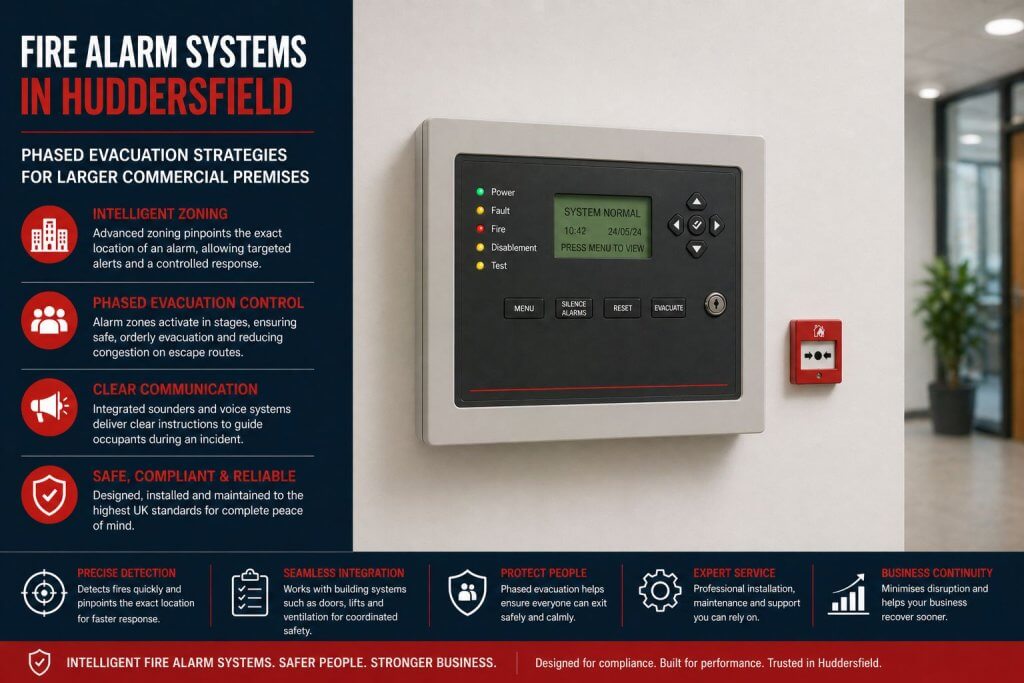
Phased Evacuation – For larger commercial buildings in Huddersfield, a standard “everyone out immediately” evacuation approach is not always the most effective or safest option. In multi-storey offices, large retail environments or complex commercial sites, a phased evacuation strategy is often more appropriate. Fire alarm systems must be specifically designed to support this approach, ensuring controlled, safe and efficient evacuation.
Phased evacuation works by clearing the building in stages rather than all at once. Typically, the area directly affected by the fire alarm is evacuated first, followed by adjacent zones if required. This reduces congestion on escape routes and allows for a more controlled movement of people, particularly in buildings with high occupancy.
In Huddersfield commercial premises such as large office blocks or public-access buildings, this approach can significantly improve safety. Attempting to evacuate everyone simultaneously can lead to overcrowding in stairwells and exits, increasing risk rather than reducing it.
For a phased evacuation strategy to work effectively, the fire alarm system must be designed with advanced zoning and control capabilities. Each area of the building must be clearly defined, allowing the system to trigger alerts in specific zones rather than across the entire site.
Addressable fire alarm systems are typically used in these environments. Because each device has a unique identifier, the system can pinpoint the exact location of an activation and respond accordingly. This allows for targeted alarm activation, supporting the phased approach.
Sounders and alert devices also play a key role. Different tones or messages may be used to indicate whether occupants should evacuate immediately or remain in place and await further instruction. In Huddersfield buildings with phased evacuation, clear communication is essential to avoid confusion.
Voice alarm systems are often integrated into these setups. Instead of relying solely on audible alarms, voice messages can provide clear, real-time instructions, guiding occupants through the evacuation process. This is particularly useful in larger or more complex buildings.
System integration enhances the effectiveness of phased evacuation. Fire alarms can work alongside access control systems, lifts and ventilation systems to support safe evacuation. For example, lifts may be recalled to a safe level, and doors released to ensure clear escape routes.
Staff training is critical in these environments. Employees and fire wardens must understand the evacuation strategy and their role within it. Without this understanding, even the most advanced system may not be used effectively.
Regular testing is essential to ensure that the system performs as expected. This includes testing not just the alarm itself, but the phased response, ensuring that zones activate correctly and communication systems function properly.
Maintenance plays a key role in reliability. All components must be serviced in line with relevant standards to ensure that the system remains fully operational. In Huddersfield commercial buildings, where systems may be more complex, this is particularly important.
Planning is also required beyond the system itself. Evacuation routes, assembly points and procedures must all align with the phased approach. This ensures that the strategy works as a complete system rather than relying solely on the alarm.
False alarms must be carefully managed in these environments. An unnecessary phased evacuation can cause significant disruption, so system design and maintenance must minimise unwanted activations while maintaining sensitivity.
Documentation supports both compliance and operational clarity. Records of system design, testing and maintenance help ensure that the system remains suitable and effective over time.
As buildings change, evacuation strategies may need to be reviewed. Changes in occupancy, layout or use can all impact how a phased evacuation should operate. Regular reviews ensure that the system continues to meet the needs of the building.
For businesses in Huddersfield, phased evacuation is a practical solution for larger or more complex premises. By combining intelligent fire alarm system design with clear procedures and staff awareness, it is possible to achieve a safer and more controlled response to fire incidents.
Ultimately, the goal is to ensure that evacuation is orderly, efficient and safe, reducing risk while maintaining control — something that can only be achieved with the right system in place.